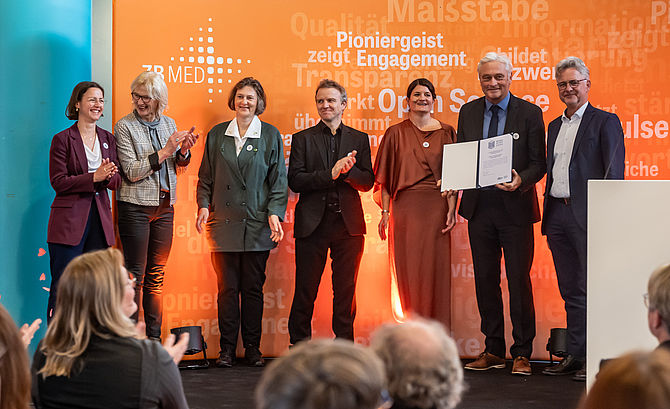
Dr. Frank Mentrup, president of the dbv, presents the ZB MED executive board with the Library of the Year award.
Academic freedom needs infrastructure: ZB MED is “Library of the Year 2026”
Greetings from the city, the state and the university
Around 150 guests attended the award ceremony in the early afternoon of 29 October. Franziska Fischer, Managing Director (Commercial) of ZB MED, welcomed the audience. The event was hosted by Ninia LaGrande, who also performed a poetry slam written especially for the occasion. The University of Cologne Jazz Choir provided the musical setting.
Greetings were delivered by Deputy Mayor Derya Karadag, First Deputy of the Lord Mayor of the City of Cologne; Prof. Dr. Andrea Kienle, Head of the Research Department at the Ministry of Culture and Science of the State of North Rhine-Westphalia; and Prof. Dr. Carien Niessen, Vice-Rector for Research at the University of Cologne.
Panel: Does science still need libraries today?
Before the award presentation, a panel discussed what academic libraries contribute to research and society. Moderated by dbv Federal Chair Antje Theise, Prof. Dr. Axel Kramer (GMS Hygiene and Infection Control / University Medicine Greifswald), Prof. Dr. Juliane Fluck, Deputy Scientific Head, and Dr. Miriam Albers, Acting Head of the Library at ZB MED, addressed the deliberately provocative question: does science still need libraries today?
The panel agreed: precisely because information now seems to be available everywhere and AI seems to have an answer to everything, we need places that stand for reliable, verifiable knowledge and independent, open access to it. Academic libraries are these places. They provide literature, research data and software, and conduct research together with the scientific community.
Laudatio: “Today, information can come to people”
In his laudatio, Dr. Heinz-Wilhelm Esser, better known as Doc Esser from the WDR health programme, described ZB MED as a “digital information infrastructure for the life sciences”. Medical knowledge changes so quickly that no one can keep it all in their head any more; what matters, he said, is finding the right knowledge, trusting data and literature, and having lasting access to them. He put it this way: “In the past, people had to come to the information. Today, the information has to come to people.”
ZB MED did not try to “somehow rescue yesterday’s library into the digital world”, Esser said, but instead rethought what a library must achieve in the 21st century. As examples, he named the search portal LIVIVO and the commitment to research data management and the National Research Data Infrastructure (NFDI). He also noted that ZB MED has campaigned for Open Access since 2003, including through the German Medical Science portal. On digital sovereignty, he pointed to OLSPub, an open complement to existing publishing and search infrastructures. He stressed that internationality works best when it takes place on equal terms.
Award presentation and thanks
Dr. Frank Mentrup, President of the dbv, Lord Mayor of the City of Karlsruhe and also a physician, presented the award. The jury recognises above all ZB MED’s commitment to Open Science and digital sovereignty in information provision, as well as its pioneering role in research data management, including in networks of the NFDI.
Prof. Dr. Dietrich Rebholz-Schuhmann, Scientific Director of ZB MED, thanked the dbv and the Ministry of Culture and Science of the State of NRW at the close of the official ceremony. He expressed particular thanks to ZB MED’s staff, who drive the institution’s transformation and digital change and, through their commitment, strengthen the values of open science in medicine.
The afternoon ended with an informal get-together, where guests and team members exchanged ideas.
Further information:
- Images and press material for download
- Video with reactions to the award
- dbv press release